MSc Internship with Green Shoots Foundation
Below are the experiences of Jeanne Vernhes who completed an internship at the AgriTech Centre during her MSc at Université Laval in Montreal, Canada. She is now once again back in Canada pursuing a PhD in International Studies at Université Laval, with an interest in civil wars, intergenerational trauma, peace processes, and the long-term impacts of conflict on communities. We appreciate her contribution to our work and invite you to read about her time in Cambodia.
This summer I completed a three-month internship with the Green Shoots Foundation, marking the final step of my Master’s degree in International Studies. During this period, I had the opportunity to travel to Samraong, in Oddar Meanchey Province, Cambodia, and spend time at the Green Shoots AgriTech Centre, a unique place where learning, agricultural innovation, and community engagement intersect.
This internship was far more than a requirement for graduation. It was a deliberate choice, driven by my desire to work at the intersection of humanitarian fieldwork, applied research, and international cooperation. I was already familiar with the themes Green Shoots focuses on (education, sustainable agriculture, and social entrepreneurship) and I knew I wanted to engage with these issues directly, within a concrete and intercultural context.
Why Green Shoots Foundation?
Several years earlier, during my academic journey, I had volunteered remotely with Green Shoots Foundation. That first involvement sparked my curiosity and admiration for their approach, but I had never witnessed their work on the ground. This internship became the perfect opportunity to “close the loop” —to observe up close, and even actively contribute to, the projects I had previously known only from afar.
Returning to Green Shoots was motivated by a need to move from theory to practice, to go beyond emails and reports, and to understand the daily reality of their work. I wanted to feel the atmosphere of the centre, meet the beneficiaries, and collaborate with the local teams. From the very first days, it became clear that the AgriTech Centre was much more than a technical training hub. It was a living space where sustainable agriculture, social entrepreneurship, and youth empowerment came together.
My role during the internship
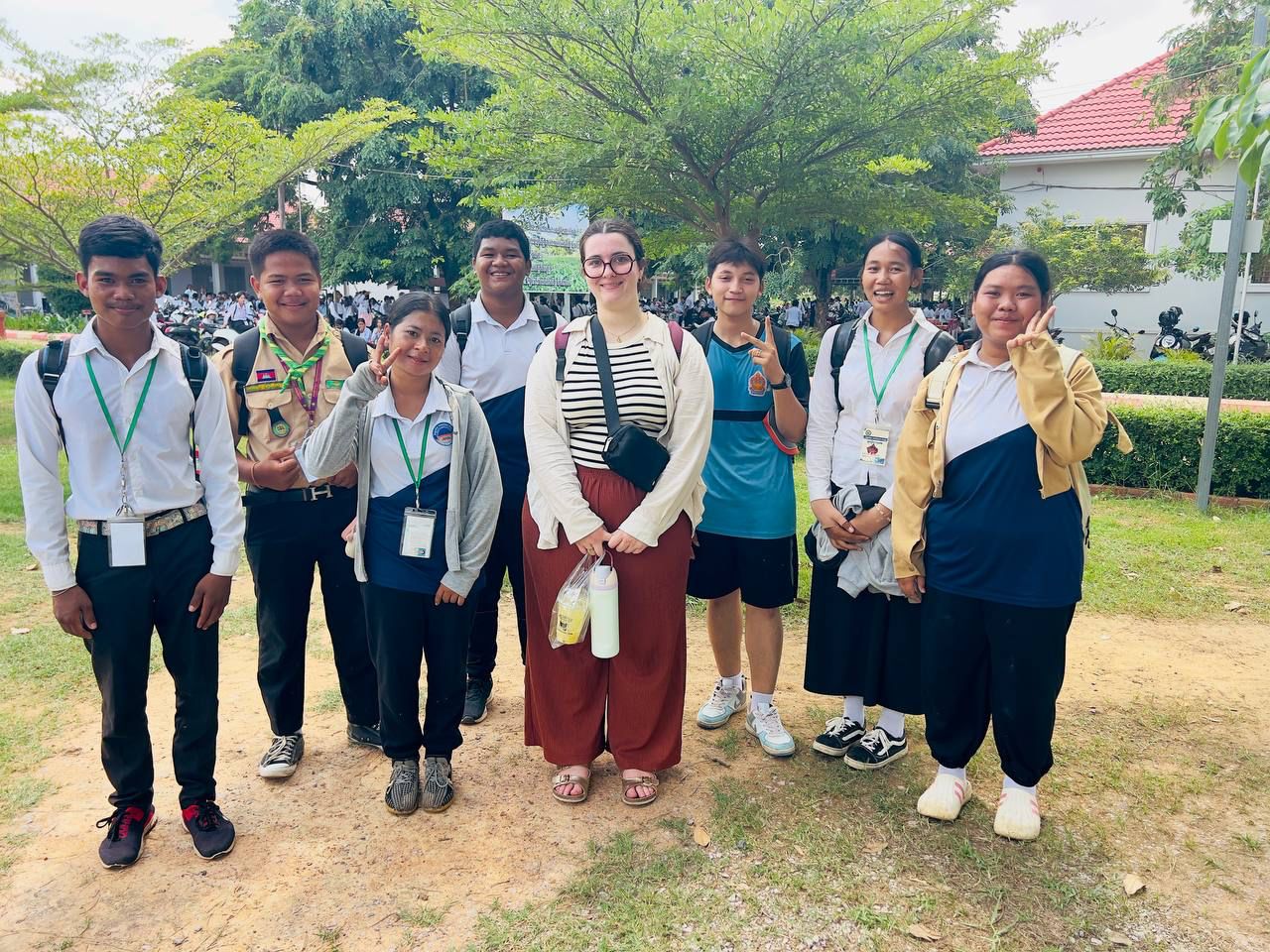
My main responsibility was to design and implement monitoring and evaluation tools to assess the social and environmental impact of the IASIP program (Integrated Agroecology: Study, Implementation and Practice). This involved facilitating five focus groups and conducting semi-structured interviews with local trainers and coordinators. These tasks were complemented by more informal but equally valuable moments. I had the chance to lead discussions with students directly involved in the IASIP program. Through their stories, I learned how they had applied the knowledge gained from the training to their own projects and communities. Some even took me to see the vegetable gardens they had created, the frog farms they had improved, or the techniques they had integrated into their daily practices. These encounters gave me a tangible sense of the program’s impact on their autonomy and allowed me to build genuine connections with them.
When I had previously worked on Green Shoots projects in an academic context, my perspective had been that of an observer: analysing from a distance, through reports, data, and case studies. Arriving in Cambodia completely shifted that perspective. I discovered the complexity of local dynamics, the constant need for adaptation, and the richness of human interactions—elements that never fully appear in written documents. Moving from theoretical study to active participation taught me that the effectiveness of a project lies not only in its design but also—above all—in its ability to anchor itself in a living, sometimes unpredictable,reality.
Although I had come to Cambodia hoping to learn from the teams and beneficiaries, I quickly realised that the exchange went both ways. During focus groups and informal conversations, I shared facilitation and analytical tools I had used in my academic research. In return, they taught me practical methods to engage students, build trust, and adapt content for diverse audiences. This reciprocity reinforced my belief that sustainable development relies as much on knowledge-sharing as on listening and mutual learning.
Key encounters: Muneezay and Mr. Kimnoeum Heng, AgriTech Centre manager.
Behind every meaningful experience, there are people who leave a mark. During my internship at Green Shoots, two individuals played a particularly important role: Muneezay Jaffery- Green Shoots Operations Manager, from afar, and Mr. Noeum, on the ground. From London, Muneezay guided me through each step. She oriented my tasks, provided a broader understanding of the organisation’s vision, and offered precise feedback that helped me grow. Despite the distance, her support remained constant and deeply reassuring.
On site, it was Mr. Noeum who shaped my experience. He helped me communicate with students—translating, reformulating, and explaining cultural nuances to avoid misunderstandings. One day, he shared his life story with me, marked by hardship but also by profound dedication to his community. His account, filled with resilience and dignity moved me deeply. Thanks to him, I gained a clearer understanding of the province, local dynamics, and the importance of genuine community involvement. His insights helped me move beyond observation and truly grasp the social and human realities shaping Green Shoots’ work.
Being at the AgriTech Centre, speaking with the young people trained through IASIP, and seeing how they had integrated these skills into their everyday lives gave new meaning to my earlier engagement. I realised that sometimes, returning to where everything began is what allows us to fully appreciate how far we’ve come.